
Scrum and Agile Glossary
Important Terms and Concepts (Take printouts and Fold at the center to make Flashcards for quick reference Terms Definition Acceptance Criteria The product characteristics specified by the Product Owner, that need to be satisfied before they are accepted by the user, customer, or other authorized entity. These are used as standards to measure and compare the characteristics of the final product with specified characteristics. Acceptance Test These tests are run from a business and customer point of view. These tests check the requested and implemented feature and determine whether these features match the business and the customer requirements Acceptance-Test-Driven Development (ATTD) A system or product development method in which the acceptance criteria are discussed extensively by the participants, through the use of examples and well-designed acceptance tests based on these criteria before development begins. Accuracy The degree by which the measured value is very close to the true value (PMI). Acquire Project Team It is the process of confirming and securing the team necessary to complete a project. Skill, experience and availability of resources are important parameters considered while acquiring project team. Adaptability Desirable characteristics in a person, team, process or system measured in the ability/capability to adapt or being adapted. In organizational context, it refers to the ability to change something or oneself to fit to occurring changes. Adaptation Modification in the product being developed or in the process of product development. Variations in the actual value and true value trigger the need for control and modification of the product or process. Adaptive planning Agile methodologies reduce waste by cutting back on work that does not add value. Planning a project does not directly add business value. Therefore, planning at any stage of a Scrum project should be as efficient as possible. Planning ahead for the whole project is considered waste, because Agile projects are prone to a high rate of change. Therefore, planning is done Just in Time (JIT). Adaptive Project Management Adaptive Project Management is a structured, iterative process of management which focuses on less up-front planning, unlike Waterfall methods. This creates an adaptable environment for teams where they focus on only the immediate tasks at hand, complete them, and then move to the next tasks. If there are any changes in requirements, then they are incorporated into the next Sprint. This ensures you to be on track with the quick-changing market and technology scenario, enabling you to deliver the greatest value in the shortest time to your customers. Additional Risk Response Planning This is done to take care of risks that were not initially identified or when the impact of a risk on objectives is greater than expected. The existing risk response planning may not be enough to control the risk. Agile Agile is a group of iterative and incremental software development methods. It encourages flexibility and speed in responding to change. It requires collaboration between self-organized, cross-functional teams to generate requirements and solutions. Agile Unified Process Agile Unified Process (AUP) is a refinement of the “IBM Rational Unified Process (RUP)” first described by Craig Larman in 2001. Agile concepts and techniques are used to select elements from RUP. Iterations are classified into two types: Development and Release. All-Before-Any A sequential development process in which the output from the previous step is used as input for the next step in the process using a batch size of 100%. Approach The method used, or steps taken in, setting about a task or problem by the Scrum team. The approach differs from team to team. Artifact Any concrete by-product formed during the development cycle. Examples of artifacts include the Product Backlog and the Sprint Backlog. Assumptions Factors which, for planning purposes, are considered to be true, real or certain. Assumptions Analysis A project management exercise that explores the validity of assumptions that were made at the beginning of the project to identify any potential project risk conceived and developed because of the inaccuracy of any assumption. It also identifies risks because of any instability, inconsistency, or incompleteness of assumptions. Basic Unified Process (BUP) BUP is a simpler variation of Rational Unified Process (RUP) developed in 2005. It was optimized for small projects by IBM. Behavior Driven Development Behavior driven development (or BDD) is a software development process which involves collaboration between non-technical or business participants and people with technical insight like developers, QA etc. Brainstorming A group activity or creative technique that can be used to generate and analyze ideas or to identify issues, risks, or even to determine solutions to problems. Burn down Chart A graphical representation of the amount of work completed/done versus the elapsed time period. It is used to estimate the time needed to complete the project. The vertical axis represents the planned work, and the horizontal work axis represents the time. The general trend in the graph is to “burn down” to a point where no work remains. Burn up Chart A graphical representation of the amount of work completed against planned over a period of time. The graphical trend line moves upward toward the goal line, hence called “burn up” in contrast to “burn down.” It is used to estimate the time needed to complete the project. Buyer-Seller relationship In a commercial project environment, a seller could be any entity (subcontractor, vendor, or supplier) who manages the work of the project or delivers the product of the project, and the buyer is the customer who outsources the work to the seller. Cadence Cadence is the approach to achieving commitment and reliability with a system. It is a measure of balance and the rhythmic flow of the process. Sprints of regular time interval or duration establish a cadence for a development effort. Capability Maturity Model Integration (CMMI) CMMI is a process improvement product suite. It was developed by the CMMI project as a collaborative industry, government, and academic effort, which combined best practices for software development. It is very effective for projects involving defined processes. Capacity Capacity is defined by the amount
Top 10 Skills Every Business Analyst Needs to Succeed
In today’s fast-paced and ever-evolving business environment, the role of a Business Analyst (BA) has become more critical than ever. Whether you’re enabling digital transformation, improving customer experiences, or streamlining operations, Business Analysts serve as the bridge between business needs and technological solutions. But what exactly makes a successful Business Analyst? Here are the top 10 essential skills every BA should master to thrive and deliver lasting impact. 1. Requirements Gathering and Analysis At the heart of business analysis lies the ability to gather and interpret requirements effectively. A successful BA must be skilled at identifying stakeholder needs, asking the right questions, and translating input into structured, actionable specifications. 2. Strong Communication Skills Business Analysts act as liaisons between business and technical teams. Clear communication includes writing documentation, facilitating workshops, and presenting insights to both technical and non-technical audiences. 3. Critical Thinking and Problem Solving BAs must analyze complex problems, identify root causes, evaluate alternatives, and recommend optimal, data-driven solutions. An analytical mindset is crucial to delivering business value. 4. Stakeholder Management Effectively managing relationships, aligning expectations, and navigating stakeholder conflicts is key to successful outcomes. Strong interpersonal skills help build trust and foster collaboration. 5. Business Process Modeling Using tools like BPMN and flowcharts, BAs model current and future processes to identify inefficiencies and improve workflows. Process modeling is vital for supporting operational improvements and transformation efforts. 6. Data Analysis and Interpretation BAs must gather and interpret data using tools like Excel, SQL, or Power BI to uncover insights and drive strategic decisions. A data-literate BA can support evidence-based recommendations. 7. Technical Proficiency and Business-IT Alignment Understanding system architecture, APIs, and SDLCs allows BAs to bridge the gap between business requirements and IT solutions. While not always coding, BAs must understand how systems interact. 8. Documentation and Specification Writing Creating clear, detailed artifacts like BRDs, FRDs, user stories, and use cases is vital for project clarity and alignment. High-quality documentation ensures shared understanding and reduces rework. 9. Agility and Adaptability Working in Agile environments and adapting to changing business needs ensures BAs remain relevant and effective. Flexibility and openness to feedback are essential in today’s iterative world. 10. Tool Mastery Familiarity with tools such as JIRA, Confluence, Visio, Figma, and Tableau enhances a BA’s ability to deliver professional, timely results. Tools improve collaboration, productivity, and precision. In Conclusion Becoming a great Business Analyst isn’t about mastering just one area – it’s about combining people skills, analytical thinking, and technical knowledge to deliver solutions that work. Whether you’re just starting out or looking to level up, focusing on these top 10 skills will set you on the path to long-term success.
SQL Training
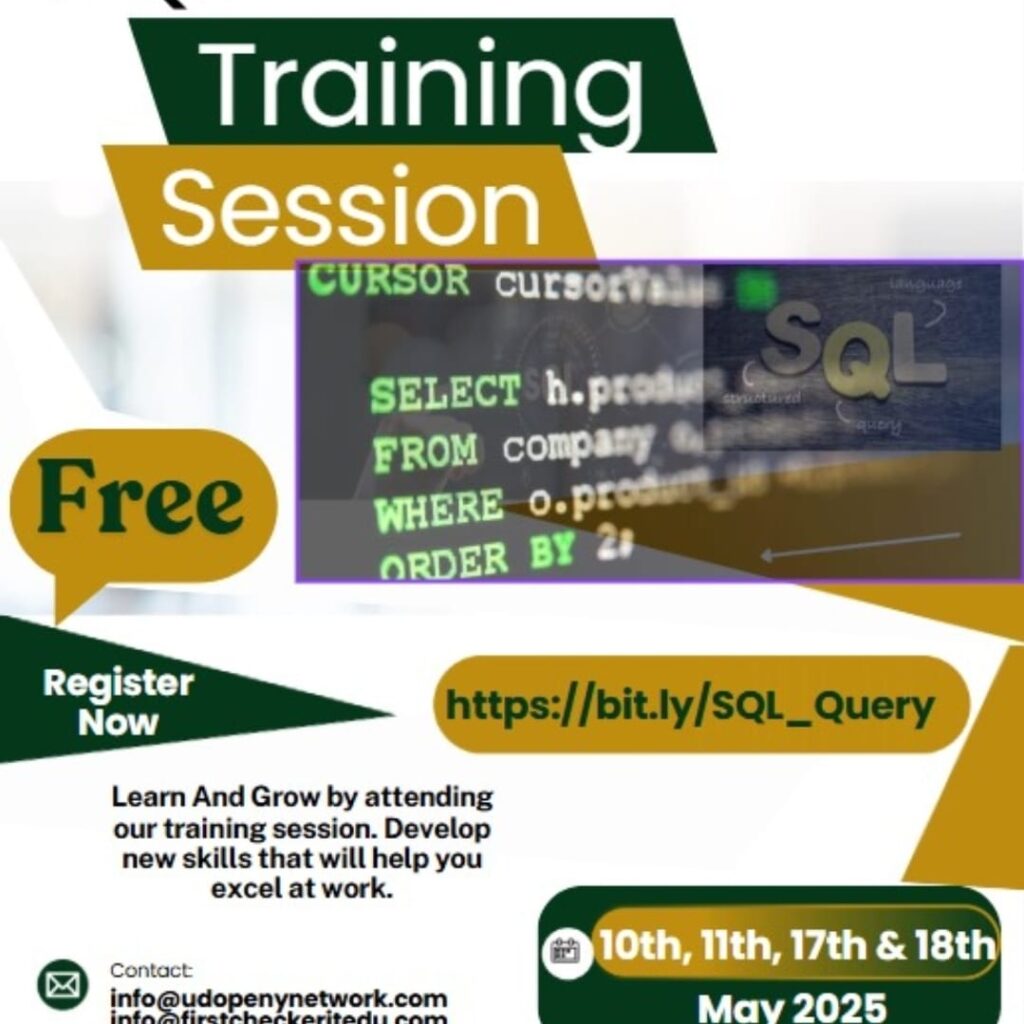
Boost Your Career with SQL Skills! Ready to take your data game to the next level?Don’t miss this FREE hands-on SQL training brought to you by @globalimpactempowermenthub, @firstcheckerit, and @udopenynetwork! Join our FREE SQL Training Session and gain hands-on knowledge to elevate your data handling and productivity at work! Training Dates:May 10th, 11th, 17th & 18th, 2025Time: 4:00 PM EST DailyLocation: Online (Zoom) Register Now: https://bit.ly/SQL_Query Whether you’re new to SQL or looking to sharpen your skills, this training is for you!What You’ll Gain:• Practical SQL skills• Boosted data confidence• Tools to thrive at work Brought to you by:Global Impact Empowerment Hub, First Checker IT Edu, and Udopeny Network Limited Contact:info@udopenynetwork.com | info@firstcheckeritedu.com Let’s learn, grow, and build brighter futures — together!